Displaying 1 - 8 of 87 articles
Clinical Programs: Student Law Office
Clinical legal education is a vital component of law school curricula, and Denver Law has been at the forefront since 1904, when we founded the first legal aid dispensary in the nation. We have provided innovative, hands-on legal education to our students ever since.
Ranked #11 by U.S. News & World Report, Denver Law's Student Law Office (SLO), our in-house clinical program, offers students the opportunity to engage in the practice of law while empowering underrepresented individuals and communities. As a working law firm within the law school, the SLO houses seven clinics: Advancing Social Change, Civil Litigation, Civil Rights, Community Economic Development, Immigration Law & Policy, Criminal Defense, and Environmental Law. These clinics train student-attorneys to become highly competent and ethical lawyers through real-life client representation. SLO faculty advise and monitor cases and projects through closure, but in the SLO the students have the primary responsibility for their clients. All of our clinics provide legal assistance to populations that often lack access to representation.
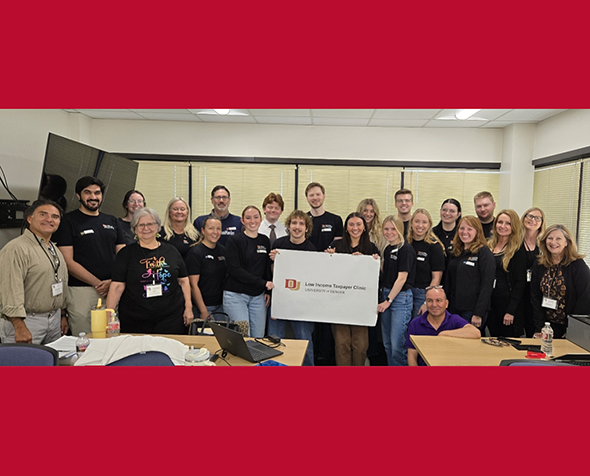
In addition to the Student Law Office, students at Denver Law can engage in the practice of law through our Legal Externship Program, as well as live-client courses outside of the Student Law Office, including the Low-Income Taxpayer Clinic, the Tribal Wills Project, and the Animal Activist Legal Defense Project.
Follow us on Instagram and LinkedIn!
- Information for Students Applying to the SLO
- Request Legal Services / Solicitar Servicios Legales
- Christopher N. Lasch Clinical Teaching Program
- Clinic News and Highlights
- Donate to the Student Law Office
Know Your Rights! Immigrants Rights Information / Conoce tus Derechos! Información Sobre los Derechos de los Inmigrantes
Download File
Applications for Spring 2027 Clinics
Applications for semester-long clinics starting in Spring 2027 will be open here on our website from 9:00 a.m. on Monday, October 26, 2026, through 11:59 p.m. on Sunday, November 1, 2026. The clinics accepting applications during this time are:
• Civil Litigation Clinic
• Criminal Defense Clinic
Please review the individual clinic webpages, linked flyers, and our application FAQs for participation requirements and submission details.
Applications for all other clinics beginning Fall semester of 2027 will open in March 2027 on our Clinical Programs website.

Information for Students Applying to the SLO
Student Law Office Clinics
#11 clinical training U.S. News & World Report
1st student law clinic in the nation opened in 1904
7 clinics

Potential Clients
Thank you for your interest. To request legal services from the Student Law Office, please complete the Request Legal Services form below and an administrator from our office will contact you within 3-5 business days of submission. Please note: The Student Law Office accepts a limited number of cases each year and cannot fulfill every request for legal assistance. However, we will do our best to provide legal resources for cases we are unable to take.
Please note: requests for the Community Economic Development Clinic, Low Income Taxpayer Clinic, and Tribal Wills Project are not processed through this form. Please visit their individual webpages for instructions.
Request Legal Services Other Colorado Legal Resources
Gracias por su interés. Para solicitar servicios legales a la Oficina de Derecho Estudiantil, por favor complete el formulario de Solicitud de Servicios Legales que aparece a continuación y un administrador de nuestra oficina se pondrá en contacto con usted dentro de 3-5 días hábiles tras la entrega. Por favor, tenga en cuenta: La Oficina de Derecho Estudiantil acepta un número limitado de casos cada año y no puede satisfacer todas las solicitudes de asistencia legal. Sin embargo, haremos todo lo posible por proporcionar recursos legales para casos que no podamos aceptar.
Las solicitudes para la Clínica de Desarrollo Económico Comunitario, la Clínica para Contribuyentes de Bajos Ingresos y el Proyecto de Testamentos Tribales no se procesan a través de este formulario. Por favor visite sus páginas web individuales para obtener instrucciones.
Solicitar Servicios Legales Otros Recursos Legales de Colorado

Christopher N. Lasch Clinical Teaching Program
The Christopher N. Lasch Clinical Teaching Program at the Sturm College of Law prepares talented and dedicated individuals to serve as future full-time clinical faculty members at U.S. law schools. Christopher N. Lasch Clinical Teaching Fellows (“Lasch Fellows”) undertake a rigorous training program involving assignment to a particular clinic within the Student Law Office and an associated three-year course of teaching, research, and study culminating in an LL.M. degree.
-
Learn More
During the course of the Program, Lasch Fellows enroll in seminars focused on clinical pedagogy and legal scholarship; supervise clinical students, first as co-supervisors with full-time clinical faculty and then on their own; assist in teaching clinical seminars; engage in client representation; and prepare one or more scholarly articles of publishable quality. Lasch Fellows receive an annual stipend and are awarded LL.M. degrees upon their successful completion of their fellowships.
Our former fellows are now teaching at law schools throughout the country — including the George Washington University Law School, University of Nebraska College of Law, University of St. Thomas School of Law, the University of Tennessee College of Law, the William S. Boyd School of Law at UNLV, University of Montana School of Law, University of Connecticut School of Law, and Widener University Delaware School of Law — as well as practicing law both locally and nationally.
The Program honors the life and legacy of Professor Christopher N. Lasch (1965-2021), who served on the faculty of the Sturm College of Law for over a decade. Professor Lasch was a fierce advocate for social justice, a nurturing teacher and mentor, and a scholar of immense range and significance who took a strong and enduring interest in the training of future lawyers and clinical law teachers. The Lasch Fellowship Program is intended to create legal educators who will continue his legacy of excellence.
When we are hiring for the Lasch fellowship, the job posting can be found at https://jobs.du.edu/en-us/listing/.

History of the Student Law Office
In 1904, Dean Lucius W. Hoyt had the foresight and vision to recognize that poor and underserved communities need legal help, and that law students could provide that help while simultaneously learning important practice skills. Thus, opened as a “legal aid dispensary” in 1904, the University of Denver was the first in the nation to offer law students academic credit for representing underserved persons. Today, DU’s Student Law Office strives to create an educational atmosphere in which law students can refine their lawyering skills while providing quality representation to indigent clients.
-
Learn More
While considered unusual in 1904, clinical legal education is now a critical part of all law schools’ curricula. Today, the University of Denver’s Clinical Program includes seven in-house clinics focusing on advancing social change, criminal defense, civil litigation, civil rights, community economic development, environmental law, and immigration law and policy.
This range of clinical offerings provides students opportunities to learn many different skills including pretrial and trial and transactional. Students have the opportunity to interview and counsel clients, develop case theory, investigate and engage in discovery, negotiate with adversaries, mediate settlements and engage in the trial of disputed matters and draft contracts and bylaws, article of incorporation and more. They learn legal ethics and practice in a range of areas including issues of confidentiality and conflict of interest. The program emphasizes case management skills, enabling students to handle their cases effectively and efficiently and develop sensitivity to and empathy for the plight of underserved clients. Faculty supervisors advise and monitor cases and projects through closure, but in the SLO the students have the primary responsibility for their clients.
Support Our Clinical Programs


Contact
Clinical Programs - Student Law Office
-
law-slo@du.edu
-
303.871.6133
-
Sturm College of Law - Ricketson Law Building
2255 E. Evans Avenue
Denver, CO 80208